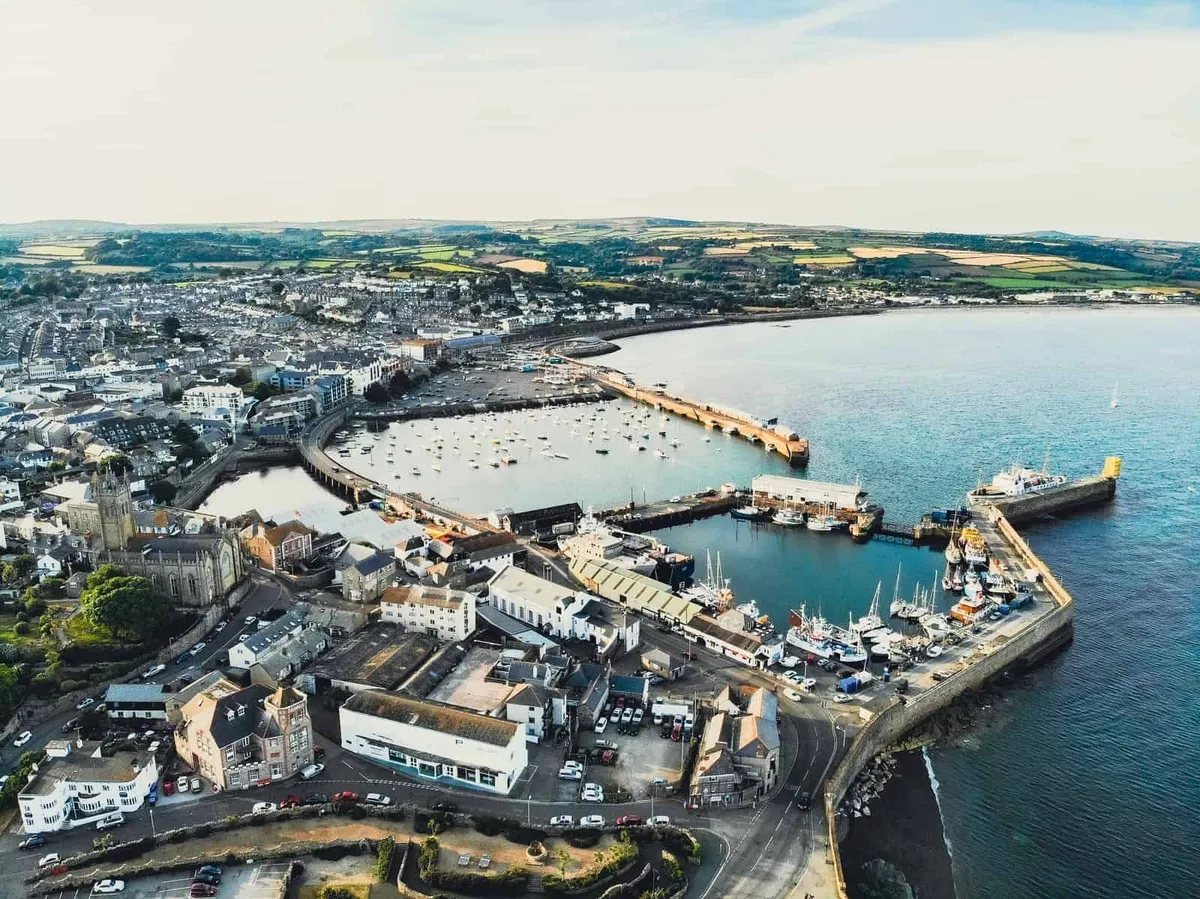
Penzance sits at the western end of Mount’s Bay, about as far south-west as you can go on the British mainland before hitting Land’s End. It is a proper working town rather than a purpose-built resort - there are supermarkets, a railway station with direct services to London Paddington (roughly 5.5 hours), and a harbour that doubles as the departure point for the Isles of Scilly ferry. The population is around 21,000, which makes it the largest town in the Penwith district and gives it a year-round character that smaller Cornish villages lack.
What makes Penzance worth a dedicated visit, rather than just a pit stop on the way to Land’s End, is the range of things within walking distance: a tidal island with a medieval castle, an Art Deco seawater lido, a subtropical garden, a gallery full of Newlyn School paintings, and a high street that has more architectural character than most towns ten times its size. This guide covers all of it.
St Michael’s Mount
St Michael’s Mount is the headline attraction - a granite island topped by a medieval castle and chapel, sitting roughly 400 metres offshore from the village of Marazion (about 3 miles east of Penzance). The mount has been home to the St Aubyn family since 1659 and is now managed in partnership with the National Trust.
Getting There
At low tide, you walk across a cobbled granite causeway from Marazion. The crossing takes 10 to 15 minutes and is straightforward in dry conditions, though the cobbles are uneven and can be slippery when wet. The causeway is exposed for a couple of hours either side of low water - check tide times before you go, as it floods faster than you might expect.
At high tide, a boat service runs from Marazion harbour to the island (March to October). The boat fee is GBP3.20 for adults and GBP1.60 for children under 16, payable even by National Trust members. Between May and mid-September, boat tickets can only be purchased with a valid castle or garden ticket.
What to See
The castle sits at the summit of the island, reached by a steep climb from the harbour. Inside, you will find the Chevy Chase Room with its hunting frieze, the Priory Church, a series of period rooms with views across the bay, and the armoury. The sub-tropical gardens cling to the south-facing slopes below the castle and open from 1 May 2026 - look out for the terraced beds planted with species that would not survive further east in the UK.
The harbour village at the base of the island has a handful of shops and a cafe. Access to the village, harbour, and island shops is free year-round - you only pay if you visit the castle or gardens. Tickets for 2026 must be pre-booked online; none are sold at the entrance. Prices vary by season, so check the official site before your visit.
Practical Notes
Dogs are welcome on the island from mid-September to late April, excluding Easter. The castle is not accessible for wheelchair users due to the steep cobbled path and steps. Allow 2 to 3 hours for the full experience including the crossing.
Jubilee Pool
Jubilee Pool is a 1935 Art Deco seawater lido built into the rocks at the eastern end of Penzance Promenade. It is one of the last surviving sea-water lidos in the UK and holds Grade II listed status. The triangular pool measures roughly 73 metres at its longest point - large enough for proper swimming rather than just paddling.
The Geothermal Pool
In 2020, Jubilee Pool became the first lido in the UK to be heated by geothermal energy. A well drilled over 400 metres into the granite below the pool pumps up water that is naturally heated by the earth. The geothermal pool - a smaller, separate section - maintains temperatures of 28 to 30 degrees Celsius, making it warm enough to swim comfortably even on overcast days. Sessions last 55 minutes and run on the hour. Pre-booking is strongly recommended, especially in summer.
Prices and Opening
The pool opens seasonally, typically from spring through early autumn. For the main pool, adult admission is around GBP6, children (under 16) around GBP4.50, and toddlers under 4 go free. The geothermal pool costs more - around GBP12 for adults - but includes access to the main pool.
Cornwall residents with a TR postcode receive a 25% discount on geothermal tickets. Penzance parish residents get steeper discounts still.
The top terrace is free to access and has a cafe serving coffee, cakes, and light meals. Even if you don’t swim, it is a worthwhile stop for the views across Mount’s Bay to St Michael’s Mount.
Classes and Events
The pool runs AquaFit sessions in the geothermal pool, swimming lessons in the main pool, and yoga on the terrace. Summer events include poolside pizza nights, Sunday Sessions with live music, and twilight swims under a full moon. The annual Newlyn-to-Jubilee Pool open water swim takes place each August.
Penlee House Gallery and Museum
Penlee House is the only public gallery in Cornwall dedicated to the art of West Cornwall. The collection centres on the Newlyn School - a group of painters who settled in nearby Newlyn in the 1880s and 1890s, drawn by the quality of the light and the availability of working fishing communities as subjects. Key names include Stanhope Forbes, Norman Garstin, and Walter Langley.
The gallery occupies a Victorian house set in subtropical gardens on Morrab Road. Exhibitions change several times a year, and between shows, the upper floor opens free of charge with a rotating selection of Newlyn School works. The permanent collection also covers local history - archaeology, social history, and the story of Penzance from its medieval origins through to the present.
Opening hours are 10am to 5pm (summer) or 10am to 4:30pm (winter), Monday to Saturday. Penzance parish residents can get a free Penzance Pass by showing proof of address. Art Fund and National Art Pass holders also get free entry.
Morrab Gardens
Morrab Gardens cover 3 acres on a south-facing slope between the town centre and the seafront. They opened in 1889 after Penzance Corporation acquired the site of a former private villa and commissioned London designer Reginald Upcher to lay out the grounds. The original Victorian layout - curving walks, a bandstand, subtropical planting - is still largely intact.
The gardens are free to enter, open dawn to dusk daily, and are worth 30 to 45 minutes of your time. The mild Penzance climate allows plants to thrive here that would fail further north or east in Britain: Cordyline palms, tree ferns, banana plants, Japanese Bitter Orange, bamboo, and olive trees all grow in the open. Many of the rarer specimens were gifted by notable Cornish garden estates including Trengwainton, Trewidden, and Tresco Abbey.
Within the grounds you will find a cast-iron fountain, the Victorian bandstand, a war memorial, ponds, and the Morrab Library - a subscription library housed in its own building within the gardens. The paths are level and accessible throughout.
Chapel Street
Chapel Street runs uphill from the harbour and is the oldest street in Penzance, with most buildings dating from the mid-18th century onward. It packs more architectural variety into a few hundred metres than any comparable street in Cornwall.
The Egyptian House
The most striking building is the Egyptian House, roughly halfway up the street. Built in the 1830s following the fashion for Egyptian-influenced design sparked by Napoleon’s campaigns, it features painted lotus columns and stylised cornices across a facade that looks entirely out of place in a Cornish town - which is precisely the point. It is Grade I listed and now contains holiday apartments managed by the Landmark Trust.
The Admiral Benbow
The Admiral Benbow at 46 Chapel Street is a pub assembled in the 1950s from two 18th-century cottages by Roland Morris, a local marine salvage enthusiast. The interior is packed with maritime artefacts and shipwreck salvage - cannons, figureheads, stern plates, and timber from vessels lost on the Cornish coast. The Captain’s Cabin restaurant is built to resemble a ship’s deck. The pub’s name references Admiral John Benbow, and local legend - not entirely reliable - connects it to Robert Louis Stevenson’s Treasure Island. The pub is one of only three in Cornwall with CAMRA heritage status.
Other Chapel Street Highlights
The Union Hotel, further up the street, is where the victory at Trafalgar and the death of Nelson were first announced to the public in 1805. The street also contains independent shops, cafes, and the Acorn Theatre, which programmes live performances and cinema throughout the year.
Newlyn
Newlyn is Penzance’s neighbour to the south - the two towns merge into each other, and you can walk between them along the Promenade in about 20 minutes. Newlyn is a working fishing port and has one of the largest fish markets in England by value. The early morning market is not generally open to the public, but you can see the activity from the harbour.
The Newlyn School of artists - Forbes, Garstin, Langley, and others - settled here in the 1880s and painted the harbour, the fishermen, and the surrounding landscape. Their legacy lives on at Penlee House and in the Newlyn Art Gallery on New Road, which shows contemporary exhibitions.
For food, Mackerel Sky Seafood Bar on New Road in Newlyn serves fish straight from the harbour in a building that dates to 1717. Chef Ben Tunnicliffe runs a seasonal menu built around whatever the boats bring in - crab, monkfish, mussels, mackerel, hake, sole. The restaurant is committed to sustainability and uses compostable packaging throughout.
Mousehole
Mousehole (pronounced “Mowzul”) sits about 2.5 miles south of Newlyn along the coastal road. It is a compact granite harbour village with narrow lanes, a curved harbour wall, and a population of around 600. The harbour is one of the most photographed in Cornwall, and the village has a genuine lived-in quality - it has not been given over entirely to holiday lets and gift shops.
The village is best known nationally for its Christmas lights display, when the harbour is illuminated with large-scale light installations from mid-December through early January. Tom Bawcock’s Eve on 23 December celebrates a local fisherman who, according to legend, braved a storm to bring home a catch that saved the village from starvation - the event is marked by the baking of Stargazy Pie, a fish pie with pilchard heads poking through the crust.
In summer, Mousehole is a pleasant place to spend an afternoon - walk the harbour wall, swim from the small beach at low tide, and have lunch at one of the harbour-side cafes. Parking is very limited (one small car park and some roadside spaces), so walking or cycling from Penzance is the least stressful option.
The Isles of Scilly Ferry
Penzance Harbour is the departure point for the Scillonian III, the passenger ferry to St Mary’s on the Isles of Scilly. The crossing takes 2 hours 45 minutes and runs from March to November, six days a week in most periods with extra Saturday sailings during peak season.
The 2026 day trip fare is GBP35 for adults, GBP17.50 for children, and GBP10.50 for infants. The ship departs Penzance at 09:15 and arrives at noon; the return leaves at 16:30 and arrives back at 19:10. That gives you roughly 4.5 hours on St Mary’s - enough to walk around Hugh Town, visit the Isles of Scilly Museum, and have lunch, or take one of the inter-island boats to Tresco or Bryher.
The Scillonian III carries up to 485 passengers and is one of only three vessels in the world that still carries Royal Mail Ship status. The crossing can be rough in poor weather - the ship passes through open Atlantic water - so take seasickness precautions if you are susceptible.
Book early for summer dates. The ferry is also the main supply link for island residents, so it runs to a tight schedule regardless of tourist demand. Skybus flights from Land’s End and Newquay Airport offer an alternative if the sea does not appeal.
Minack Theatre
The Minack Theatre is about 10 miles south-west of Penzance, carved into the granite cliff above Porthcurno Beach. Rowena Cade began building the theatre by hand in the 1930s, and it now seats 750 across terraces cut into the rock, with the Atlantic Ocean as the backdrop. The season runs from May to September, with a programme of plays, musicals, and concerts.
Even outside the performance season, the theatre is open as a visitor attraction. The exhibition centre tells the story of Cade’s remarkable construction project, and the terraces offer views along the coast toward the Lizard. Porthcurno Beach below is one of the most attractive in West Cornwall - white sand, turquoise water, and relatively sheltered by the headlands on either side.
Penzance Promenade
The Promenade extends for about a mile along the seafront, running from Jubilee Pool near the town centre south-west to Newlyn. It is a flat, paved walkway with benches, a children’s playground, a skate park, flower beds, and stretches of shingle beach. On clear days, the view across Mount’s Bay takes in St Michael’s Mount to the east and the sweep of the coastline toward Mousehole to the south.
The Promenade is one of the best free activities in Penzance - a morning walk from one end to the other and back takes about 40 minutes and passes sculpture installations and Victorian-era shelters. The Battery Rocks area near Jubilee Pool has natural rock pools and a sheltered swimming spot at high tide.
Where to Eat
Beyond Mackerel Sky in Newlyn, Penzance has several restaurants worth knowing about.
The Shore
The Shore on Alverton Street is a reservations-only restaurant seating just 10 diners at a time. Chef Bruce Rennie works alone in the kitchen, preparing a set tasting menu that changes regularly and leans heavily on Cornish seafood with Japanese influences. The format is intimate - all guests eat each course at the same time, and Rennie presents the dishes himself. The restaurant is listed in the Michelin Guide and consistently appears in national “best of” lists. Book well in advance.
Other Options
Harris’s Restaurant on New Street has served seafood and modern British food since the 1970s. The Turk’s Head on Chapel Street claims to be one of the oldest pubs in Penzance and serves pub food and real ales. For daytime eating, Archie Brown’s on Bread Street is a long-running vegetarian and wholefood cafe, and the Honey Pot on Parade Street does solid breakfasts and lunches.
For more dining ideas across the county, see our best restaurants in Cornwall guide.
Practical Tips
Getting there - Penzance is the terminus of the Great Western Railway main line. Direct trains run from London Paddington (roughly 5.5 hours), with stops at Plymouth, Truro, and St Erth. By car, it is about 4.5 hours from Bristol via the M5 and A30.
Parking - The Harbour car park and Wharf Road car park are closest to the town centre. The railway station car park also takes visitors. Rates vary by season. Street parking exists but is limited and time-restricted.
Best time to visit - Late May to June and September are the sweet spots. Jubilee Pool and St Michael’s Mount are both open, the weather is generally good, and accommodation prices are lower than in July and August. Winter visits suit those who want quiet walks, Chapel Street shopping, and Penlee House without the crowds.
Combining with other towns - St Ives is about 20 minutes by car or a short train ride from St Erth. Marazion is about 3 miles east and serves as the access point for St Michael’s Mount. The Minack Theatre and Porthcurno are about 25 minutes by car. Penzance works well as a base for exploring the whole of West Cornwall.
For places to stay in the area, see our accommodation guide.